

Original Rum Stories: A Pacific Hypothesis
Field notes from a strategy dive into the evolution and history of NZ rum, inspired by curiosity.

Photo by Pieter Janaldo on Unsplash
Do you remember your first Rum’n’Coke? Overdo the Coruba at a Scarfies party one time? We’ve been a rum nation since way back when the Bay of Islands was still a hellhole of Pacific trading—and the consumption numbers suggest nothing much has changed. But NZ craft producers seem convinced the market isn’t ready for them. So I’ve been searching for a cultural landmark, a navigational waypoint to understand why Kiwis love rum but according to some, just not in the right way.
I can’t remember tasting rum for the first time. I can’t remember my first rum and Coke, can’t remember the first time I ordered a sipping rum in a bar, can’t tell you which bottle taught me what rum was supposed to taste like. Rum has been ubiquitous in my life in the way that fish’n’chips, sandy toes or the smell of mānuka bush in full summer is. It was always there. Which is why I feel friction every time a New Zealand rum maker tells me we don’t have a rum culture yet.
There is. There absolutely is. It’s just not the rum culture they’re trying to sell into. But rather than get into an argument, I have turned my attention to curiosity, research and discovery. Mostly in the hopes of redeeming the Pacific rum drinker and the glorious wonder of a great Rum’n’Coke. Because from botanical rum to unique sugar to experimental ferments, we’ve got a treasure trove of makers doing fascinating things with rum but for the most part, Kiwis love Caribbean flavour. So whether it is simply price, market penetration or the dastardly product-market fit, I want to understand, then crack the rum code. Like pirate code but tastier.
I’m not the only one stuck on the same kind of perplexion. A New Zealand producer told me recently that the local drinker isn’t sophisticated enough yet — that the category needs the consumer to ‘grow up’. An Australian producer told me, in the same fortnight, that of course New Zealand can’t have a rum culture, because we don’t grow the organic material. Two different countries, two different theories, both pointing at the same supposed deficit. And both, I’ve come to think, reading the wrong map.
I’ve been pulling at this thread for about nine months. What I keep coming back to is this: we have a rum culture. It’s just some don’t like that it’s focused on imported Caribbean products that are highly approachable (we’d prefer more complexity and sophistication), affordable (produced often in very large scale vs ‘craft’ producers) and often come in a can. We wrestle with that version of our rum-drinking identity while missing the historical and authentic one on our doorstep. There is no need to create a NZ rum story because the older, authentic and historical Pacific rum story already exists.
The rum culture we don’t want to admit we have
Walk through the shared memory of any Australasian drinker over thirty and you’ll find rum sitting in the foundations. Bundaberg & ginger or Coruba & Coke at the work BBQ. Malibu and pineapple on someone’s deck, the bottle going soft in the sun. Coruba in the hip flask, in the Christmas cake, in the Black Heart bottle your grandfather kept in the cupboard for reasons nobody questioned. The Bundy bear staring out from every duty-free shelf between Auckland and Brisbane. A generation of school socials that ran on Bacardi. A whole RTD aisle that is, when you read the back of the can, mostly rum doing the structural work.
This is a rum culture, dressed as something else — summer, holiday, party, fishing trips. Then we built a craft conversation that quietly assumed none of this counted, because the bottles didn’t have provenance stories and the drinkers didn’t ask for them. The drinker who has Black Heart in the freezer isn’t unsophisticated. They have a relationship with the category. It’s the producer’s relationship with that relationship that might be missing. Product designers don’t wait for consumers to meet the category, they design for the consumer existing in the category.
I was sitting with Kelvin Soh recently — who led the iconic brand development for Stolen Rum — and was reminded how cleanly that brand solved the problem the rest of the category keeps tripping over. Stolen didn’t pretend over it’s rum origin. The provenance is on the label, honest about where the spirit comes from. What it claimed instead was a New Zealand relationship with rum — irreverent, urban, designed for the way people here actually drink the category rather than the way modern producers wished they would. That’s a brand built on the rum culture we already have, not the one we keep apologising for not having. Best Behaviour have done a different version of the same move with manuka and the off-the-beaten-track adventure vibe. The category isn’t broken everywhere. It’s just stuck in the places where the story still hasn’t landed.
Which brings me to the part of the thread I keep pulling on. If Stolen got the honesty right at the brand layer, the next move is the honesty about geography.
A different map
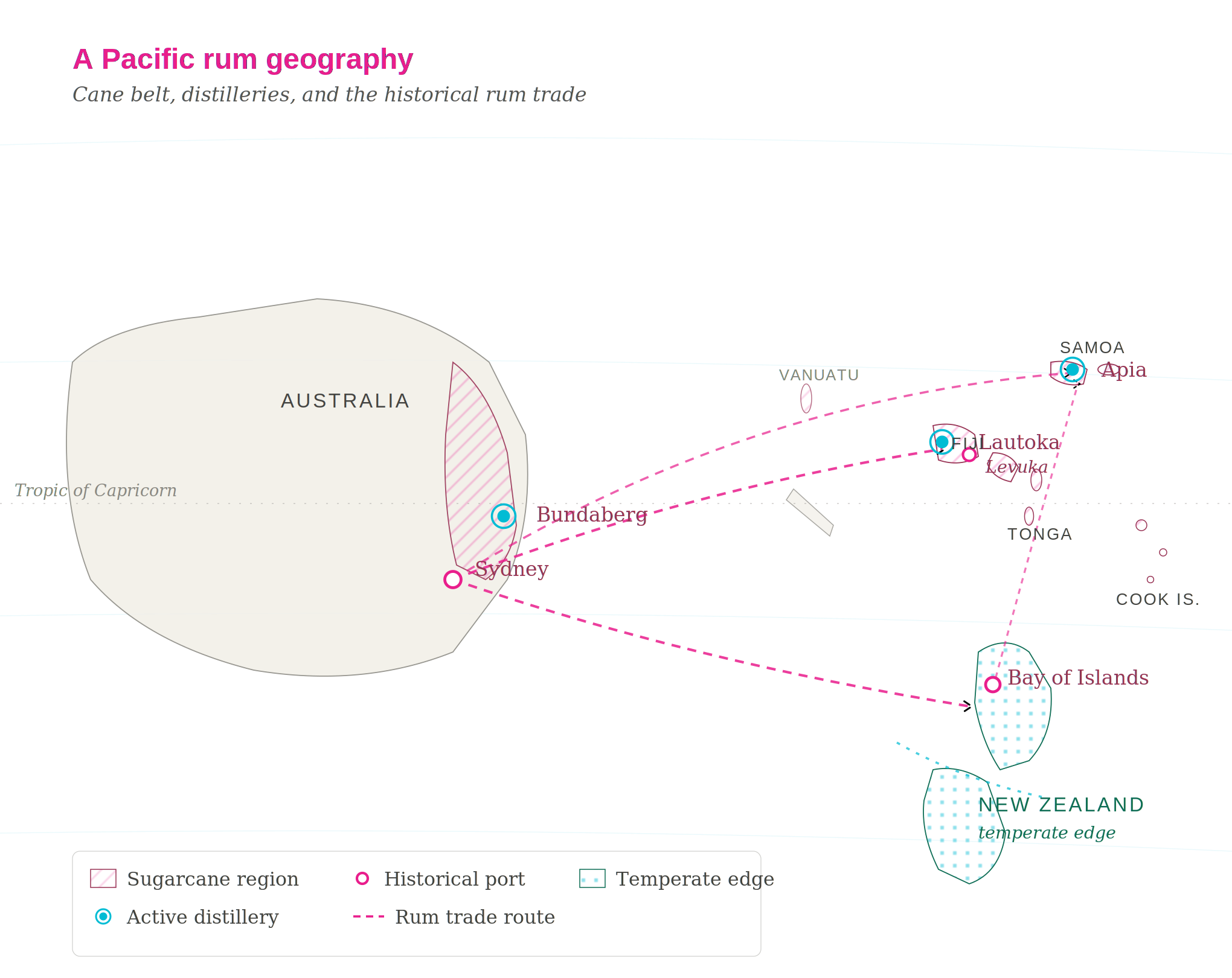
This is, in part, a history story as much as a geography lesson. Rum was the first spirit consumed, traded, and produced in the Pacific and Australasia at any meaningful scale — it moved through these waters with whalers and sealers and missionaries, paid the labour of the cane plantations, and crossed every frontier the colonial period opened up.1 It is, hellhole as that colonial history was — Charles Darwin used precisely that phrase about Kororāreka in the Bay of Islands2 — the spirit with the deepest commercial footprint in this region. Soon may the Wellerman come, to bring us sugar and tea and rum. That’s a New Zealand whaling song. The shore stations at Tory Channel and Cloudy Bay and Otago paid their crews in slops and tobacco and rum, not cash.3 In Sydney, the New South Wales Corps ran the colony on rum as currency for the better part of two decades and staged a military coup over it in 1808.4 To pretend rum is a foreign category we’re trying to import a culture for is to ignore a documented lineage that runs through the ports of Sydney, the Bay of Islands, Lautoka and Apia. The footprint and our rum-drinking heritage is written on a map, with more depth than a geological survey.
If we keep asking whether New Zealand can be a rum country, we keep arriving at the same dead ends — no significant sugarcane, no heritage, no consumer pull-through. But that’s a local perspective on what is historically and structurally a regional category. Rum has always been regional—The Caribbean isn’t the only rum region on the planet. It’s the one we’ve been told to compare ourselves to. The Pacific is a rum region. Sugarcane is, in fact, Pacific in origin — domesticated in New Guinea around eight thousand years ago and carried across the ocean by Austronesian voyagers long before it was loaded onto European ships.5 Fiji’s commercial rum distillery, opened in 1979, sits on top of a much older sugar economy that ran more than thirty mills at its nineteenth-century peak.6 Samoa, Tonga, the Cook Islands all have cane traditions in depth. The Queensland cane belt runs straight down into Bundaberg, the largest rum producer in the southern hemisphere.7 The geography we’re actually part of is tropical and sub-tropical, anchored in the Pacific, with deep heritage. Sure, we’re at the temperate southern edge of it, but it’s still ours.
The temperate edge, and what it might mean
The technical part of this rum identity hypothesis is where I’m most confident. Tropical rum loses 7 to 10 percent of the barrel to the angels every year. New Zealand maturation runs at 2 to 3 percent anecdotally.8 Slower oxidation, longer playing time on the wood, different ester development. A Pacific rum category with regional variation would have Fijian heat-aged, Samoan tropical, Australian sub-tropical, and New Zealand temperate sitting alongside each other in conversation, but with better sub-branding. The way Scotch has Islay and Speyside. The way Cognac has Grande and Petite Champagne.
Inside that frame, the New Zealand role gets coherent for the first time. We’re a cool-climate maturation house at the slow end of a fast region. There’s opportunity for brand strategy in that, a sourcing story about Caribbean rum loved at the edge of the world, an export logic, and a tasting note all at once. It also means the producers here could start participating in a regional category conversation that already has scale and depth. In whisky, I’m studying the arid climates and the impact on ferments and maturation across the Outback and the dry Central Otago alpine ranges. In Pacific rum, the same conversations and threads regarding aging and ferment impact exist.
What I’m testing, and who I’m asking
I’m not convinced you build a category like NZ or Pacific Rum from a technical basis. It starts with the brand positioning of history, geography and authenticity. With the relationship I have with occasion and the places I reach for that familiar sweet and vibrant flavour. The line between recognising we’re part of a Pacific rum geography and aestheticising Pacific identity for shelf appeal is real, and not one to get wrong. But it is authentic to embrace and understand the rich and toruble heritage of rum in each corner of our region. Queensland has history but so do Northlanders. And history goes hand in hand with culture.
So this is an invitation to the hypothesis, on the page, while I’m still working it out. Rum culture in New Zealand isn’t missing. It’s been misnamed, misunderstood and sometimes diminished just because it doesn’t look as “sophisticated” as the craft branding coming out of more traditional regions. Some of those producers are actively building brands built on rebellion against tradition. Is it just we’re not comfortable living with the terrible colonial rambuctious past in our brand stories? We’re bouncing between no tradition and trying to create one. The story we should be telling has been on our doorstep the whole time. The producers who’ve already cracked the brand layer — Stolen, Rum Co of Fiji — show that the category responds when somebody actually tells it straight.
If you’ve been thinking adjacent to this — producer, distiller, buyer, trade person, anyone — I want to hear from you. This is my hypothesis and from here, I think there’s great discussion to be had about what and who is the Pacific rum drinker, lover and producer.
References
1. For the broader history of rum as colonial currency and trade good, see Ian Williams, Rum: A Social and Sociable History of the Real Spirit of 1776 (Nation Books, 2005), and the Oxford Bibliographies entry on rum in Atlantic history: https://www.oxfordbibliographies.com/display/document/obo-9780199730414/obo-9780199730414-0155.xml
2. Charles Darwin’s “hellhole of the Pacific” description of Kororāreka, recorded during his 1835 visit, is widely cited in New Zealand colonial history. See Te Ara — The Encyclopedia of New Zealand, “Ship-based whaling”: https://teara.govt.nz/en/whaling/page-1
3. On payment of New Zealand shore whalers in rum and other goods, and the origins of the Wellerman song, see Te Ara — The Encyclopedia of New Zealand, “Sealers and whalers”: https://nzhistory.govt.nz/culture/pre-1840-contact/sealers-and-whalers; and “Pohatu-koko and the Whalers”: https://www.cplay.co.nz/stories/detailed-stories-to-share/23-pohatu-koko-and-the-whalers
4. On rum as currency in early New South Wales and the 1808 Rum Rebellion, see State Library of New South Wales, “The 1808 Rum Rebellion”: https://www.sl.nsw.gov.au/stories/1808-rum-rebellion; National Museum of Australia, “Governor William Bligh is deposed in the Rum Rebellion”: https://www.nma.gov.au/defining-moments/resources/rum-rebellion; and Matt Murphy, Rum: A Distilled History of Colonial Australia (2021).
5. On the New Guinea origin of Saccharum officinarum and its Austronesian distribution across the Pacific, see CIRAD, “The origin of sugarcane revealed” (2025): https://www.cirad.fr/en/press-area/press-releases/2025/origin-of-sugarcane-revealed; and University of Hawaiʻi at Mānoa Library, “Sugarcane — Traditional Pacific Island Crops”: https://guides.library.manoa.hawaii.edu/paccrops/sugarcane
6. On Fiji’s nineteenth-century sugar economy and the establishment of South Pacific Distilleries (now Rum Co. of Fiji) in 1979, see Single Cask Rum, “Fiji”: https://singlecaskrum.com/countries/fiji/; and TDC Fiji, “Rum Fiji”: https://tdcfiji.com/rum-fiji.html
7. On Bundaberg and the Australian rum industry, see National Geographic, “The complex history of Australian rum — and the best places to find it”: https://www.nationalgeographic.com/travel/article/history-best-rum-distilleries-australia
8. On angels’ share figures across tropical and temperate maturation climates, see Drinks International, “Aged rum: Devil’s in the detail”: https://drinksint.com/news/fullstory.php/aid/11218/Aged_rum:_Devil_92s_in_the_detail.html; Ethimex, “How Climate Affects Rum Ageing”: https://www.ethimex.com/knowledge-articles/how-climate-affects-rum-ageing-the-art-and-science-of-maturation/; and NM Spirits Consulting, “Why Are There 40-Year-Old Whiskies but Few Aged Rums?”: https://www.nmspiritsconsulting.com/en/why-are-there-40-year-old-whiskies-but-few-aged-rums-copy